Mannequin
A full-body rig for putting all of the above together: poses, weight and full-figure mechanics.
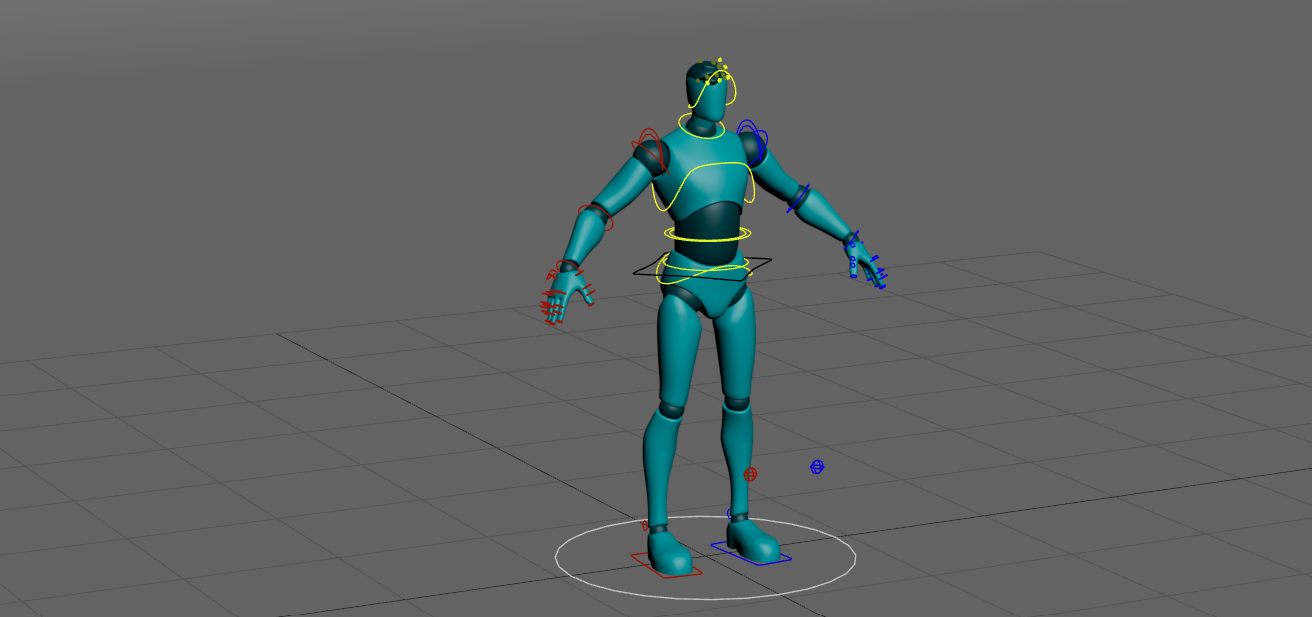
The mannequin removes the constraints that made the previous five rigs teachable. It has enough joints to do anything, which means it has enough joints to go wrong in every way the earlier exercises isolated, all at the same time, and now with the added problem of a figure that reads as a body and therefore invites the audience to judge it as one.
Nothing new is being introduced here. Everything required was covered by the first five rigs. What is new is that all of it is required simultaneously, and that is a genuinely different skill from doing any one of them well.
What it teaches
The rig's default pose is your opponent. A character rig at rest is perfectly symmetrical, and symmetry reads to the eye as manufactured rather than alive. Every joint you leave alone stays twinned. This is not a stylistic preference. It is an active fight, on every pose, every time.
Poses carry the meaning; the motion between them only inherits it. Movement is a transition between held ideas, so weak poses cannot be rescued by good timing. This is the argument the Strong vs Weak Poses masterclass makes at length, and the mannequin is the rig it was written for.
The body is a chain, like the pendulum. Hips lead, spine follows, shoulders answer, head arrives last. Everything learned about overlap applies directly. The difference is that the chain now branches.
Exercises
- A pose, held. No motion at all. Line of action, silhouette, weight, asymmetry. Get one frame right before animating anything.
- Two poses and the transition between them. The whole discipline in its smallest possible form.
- A jump. Anticipation, launch, suspension, landing, recovery. Every rig in this set contributes to it.
- A weight lift. Pure body mechanics: where the mass is, and what the body does to support it.
What to watch for
- Twinning. Both arms at the same angle, both legs equally bent, hips and shoulders squared. Go through every finished pose asking what is still mirroring.
- The line of action. Trace one curve from the crown of the head to the feet. If it is vertical, the pose is inert.
- Silhouette. Fill the figure with solid black. If the action is not readable, no amount of detail will rescue it.
- The settle. Landings and stops need the body to keep resolving after contact. Stopping dead reads as weightless, retroactively.
The most common failure
Reaching this rig too early. A student who arrives here without having animated the ball, the pendulum and the legs has no diagnostic vocabulary. When the animation feels wrong they cannot tell whether the problem is timing, overlap, weight or pose, because they have never seen those problems in isolation. The mannequin is where the earlier exercises get spent, not where they get learned.