Hammer
Arcs, anticipation and the feeling of real mass swinging through a scene.
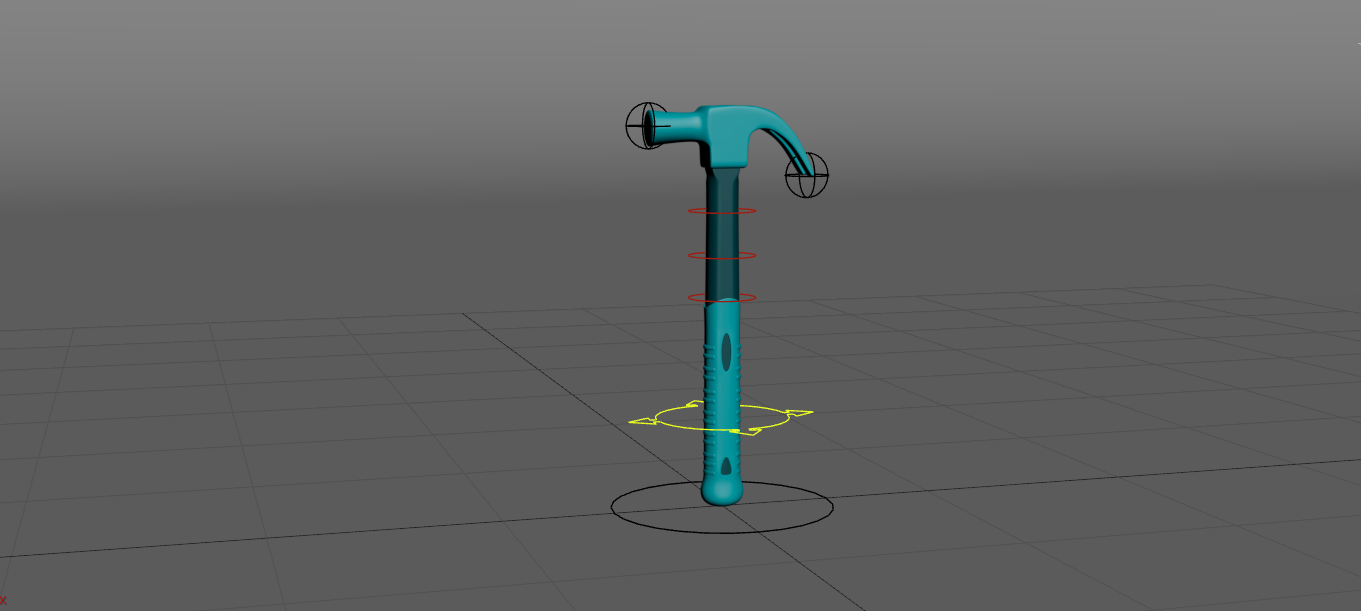
A hammer is a lever with the weight concentrated at one end, and that single fact makes it an unusually strict teacher. Everything about how it moves is dictated by where its mass sits. Animate it as though the weight were evenly distributed and the error is immediately legible, in a way that the same mistake on a character rig is not.
What it teaches
Arcs are physics, not polish. A swinging object pivots, and pivoting describes a curve. A hammer head travelling in a straight line has been moved rather than swung, and the audience registers this instantly even if they cannot name it.
Anticipation is proportional to force. A heavy strike needs a large wind-up; a tap needs almost none. Getting this relationship right is what makes the weight legible before the impact happens. The audience knows how heavy the hammer is from the preparation, not from the blow.
Impact is not the end of the action. Force has to go somewhere. The hammer rebounds, the handle flexes back, the whole object resolves. An animation that stops at the moment of contact reads as the hammer hitting a wall of nothing.
Exercises
- A single overhead strike. Anticipation, swing, impact, recoil. Four beats, and each one is doing a distinct job.
- The same strike, twice the weight. Change only the wind-up and the recovery.
- A miss. Swing through and let the momentum carry. No impact to absorb the force means everything must be resolved by the body of the motion.
- Track the arc. Turn on a motion trail and check that the head's path is a clean curve throughout.
What to watch for
- The head leads. The weighted end drives the motion and the handle answers to it. Animating from the handle produces something that reads as weightless.
- Speed varies enormously. Slow through the wind-up, fastest just before impact, abrupt stop, then a slower recovery. Even spacing anywhere kills it.
- The path of the head is the single most useful thing to check. If the arc breaks, so does the illusion.
- Contact should be the fewest frames in the shot and the most extreme pose.
The most common failure
No recoil. The hammer descends beautifully, connects, and simply stops. Because force must be absorbed or transferred, a hammer that lands and holds still tells the audience it weighs nothing, undoing the entire wind-up that preceded it. This is the same error, in miniature, that shows up in landings on character work.
Last in the set: Mannequin, where all five problems arrive at once.