Ball and Legs
The first taste of locomotion: contact, weight transfer and stepping, without a full character to manage.
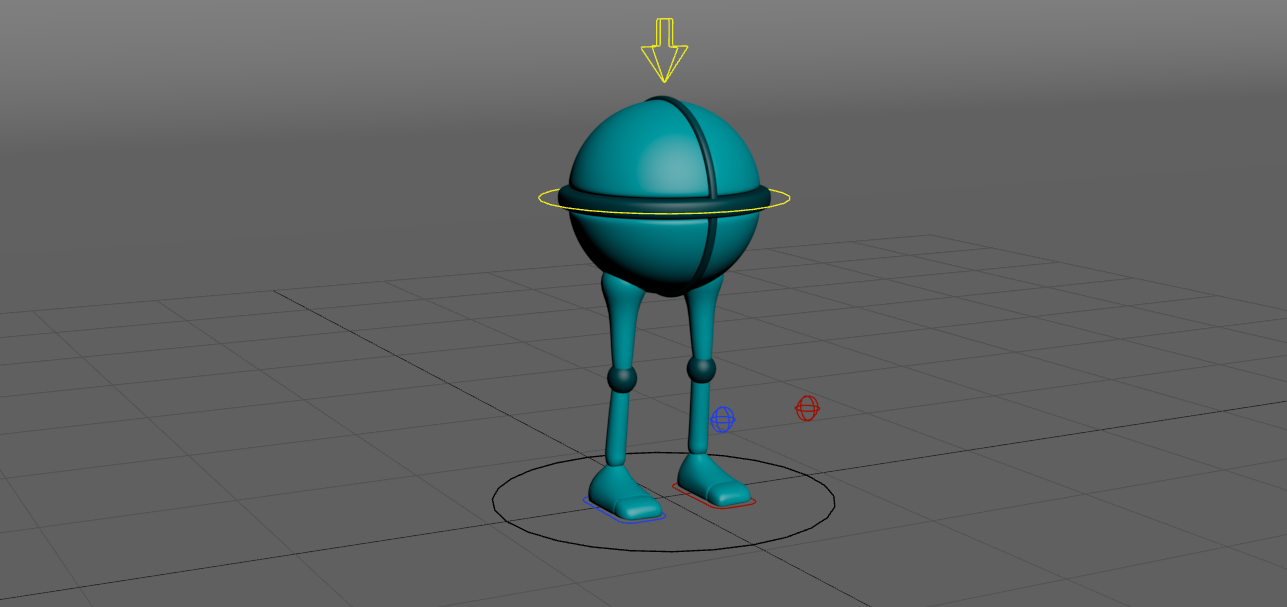
Adding legs changes the problem entirely. Up to this point the rig has been acted upon: thrown, swung, dropped. With legs it becomes capable of pushing against the ground, and the animator becomes responsible for something new: where the mass is, at every frame, and what is holding it up.
The ball body is kept deliberately simple so that attention stays on the transfer of weight rather than on a torso, arms and head all needing solutions at once.
What it teaches
Weight is a question of support. At any moment the audience is reading which foot is carrying the body. Ambiguity about that, with mass floating between two supports with neither committing, is the single most common reason a walk reads as weightless.
Contact is a contract. A planted foot does not move. Not slightly, not for one frame. Ground slip destroys the illusion faster than almost any other error because the floor is the one thing the audience knows is not moving.
The body follows the support, not the other way around. Beginners animate the body along a path and place the feet underneath it. Reversing that (plant the foot, then move the mass over it) produces convincing weight almost immediately.
Exercises
- A single step. One weight transfer, nothing else. Get the shift convincing before you make it repeat.
- A two-legged hop. Both feet leaving and landing together: anticipation, air, absorption.
- A walk cycle. Contact, down, pass, up. The down position is where the weight is proved.
- A heavy step and a light step using the same contacts and different timing.
What to watch for
- The down position. Immediately after contact the body should drop as the leg absorbs the load. Skipping it is why so many walks float.
- Hips over the support. If the centre of mass sits outside the base of support, the character should be falling.
- Foot sliding. Check the planted foot frame by frame in a side view. It is easy to miss and impossible to unsee.
- Asymmetry. Even a neutral stance has one leg doing more work than the other.
The most common failure
Legs animated as a cycle laid underneath a body travelling at constant speed. The result is technically a walk and reads as a puppet on rails, because the body never responds to the legs. It never rises over the pass position, never drops into the contact, and so never appears to weigh anything.
Next: Hammer, which returns to a single object and makes arcs unavoidable.