Hank
A full acting rig: squash and stretch with volume retention, IK/FK spine, and complete facial controls for dialogue work.
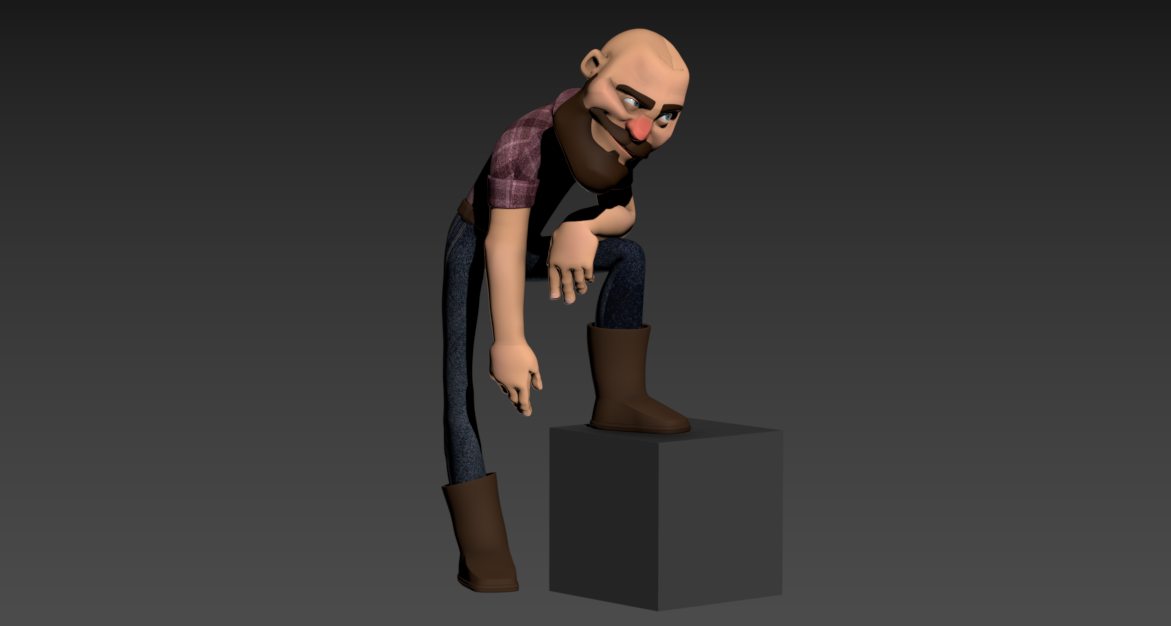
Hank carries the same control set as Emma: a body capable of proper mechanics, and a face detailed enough to act on top of it. The one difference is that the finger sliders are not present here, so hands are shaped through the controls directly.
Having a second character with the same capabilities matters more than it might appear. Performance is comparative work, and running the same beat on two different figures is one of the fastest ways to find out how much of a performance was the idea and how much was the face you happened to be using.
What the rig offers
- Squash and stretch controls through the body, for pushing proportion on strong poses and impacts
- Volume retention controls, so deformation can be pushed without the figure appearing to inflate or deflate
- An IK/FK spine, switchable, giving both a steerable torso and a torso that hangs naturally from its parent
- Full facial controls, covering the brows, the eyes and the mouth
- Mouth shapes for dialogue, driving the visible phoneme rather than only opening a jaw
- Eyebrow controls, which carry more of the emotional register than any other part of the face
What it teaches
Attitude is established by the spine before anything else. A switchable IK/FK torso is the main tool for this. FK lets the upper body hang and settle from the hips, which is what a relaxed or defeated character does. IK holds the chest where you put it regardless of what the hips are doing, which is what a braced, defiant or held posture requires. Choosing between them is a character decision, not a technical one.
Stillness is a performance, not a gap. The strongest acting beats are often the ones where a character stops. Mechanics timing has a floor, since a body of a given mass falls at a given rate, but performance has none. Holds can run far longer than feels comfortable while animating and still read as rushed when watched at speed. A character who stops moving is doing something, and an audience will read meaning into it.
Changes of mind are the most valuable beats available. Thought is only visible at the moment it changes direction. A character who arrives somewhere, reconsiders, and goes elsewhere has demonstrated an interior life in a way that no held expression can.
Weight applies to performance as much as to mechanics. A character who shifts their balance during a line is thinking about something. One who stands evenly on both feet through an entire shot is a mannequin with a moving face. Every principle from the body mechanics rigs is still running underneath the performance.
Hands without sliders take deliberate attention. With no shortcut available, the risk is simply leaving them in the rig default, which contradicts whatever the face is claiming. Building two or three hand poses at the start of a shot and reusing them costs very little and removes the excuse.
Exercises
- The same line, two postures. Identical dialogue and identical mouth shapes, one performance built on an FK spine hanging from the hips, one on an IK spine holding the chest. The reading changes completely.
- A reaction with no dialogue. Something happens off screen. Eyes first, then brows, then the body.
- A held moment. Find the longest hold you can make work. Then extend it and find out you were wrong about the limit.
- A shot run on both rigs. Animate the same beat on Hank and on Emma, and see what survives the change of face.
What to watch for
- Eyes lead the head. Attention shifts before the body follows. Reversing that order reads as a machine tracking a target.
- Blinks as punctuation. They land at the ends of thoughts and on changes of direction, not on a timer.
- Facial symmetry. Expressions are asymmetrical. Offset the brows and favour one side of the mouth.
- Over-articulated dialogue. Fewer, stronger mouth shapes on the accented syllables beat a shape for every phoneme.
- The default hand. Check it before you call a shot finished.
The most common failure
Treating the face as the performance. The face specifies what a posture already established, so a shot whose body is not carrying the intention has nothing for the face to specify. Build it so it reads in silhouette with a blank face, then let the face say which of the available meanings is the right one.