Emma
A full acting rig: squash and stretch with volume retention, IK/FK spine, complete facial controls, and slider-driven fingers.
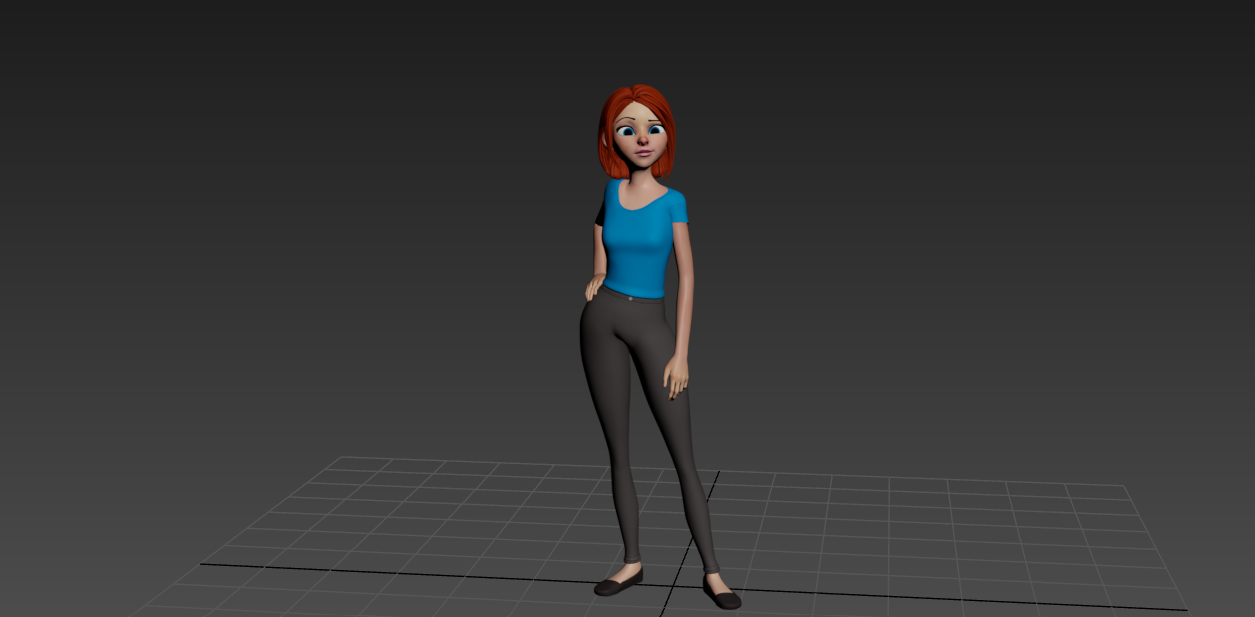
Emma is built for performance work. The body is capable enough to carry weight and mechanics properly, and the face is detailed enough to act on top of it, which is the combination dialogue work needs.
What the rig offers
- Squash and stretch controls through the body, for pushing proportion on strong poses and impacts
- Volume retention controls, so deformation can be pushed without the figure appearing to inflate or deflate
- An IK/FK spine, switchable, giving both a steerable torso and a torso that hangs naturally from its parent
- Full facial controls, covering the brows, the eyes and the mouth
- Mouth shapes for dialogue, driving the visible phoneme rather than only opening a jaw
- Eyebrow controls, which carry more of the emotional register than any other part of the face
- Finger sliders, allowing a whole hand to be shaped from a small number of values instead of posing each joint
What it teaches
A performance is distributed across the whole figure, and the body reads first. Posture is visible at any distance, so it establishes the attitude of a moment before the face does anything. The face then supplies the specificity: which of several possible emotions that posture is actually carrying. When the two disagree the audience believes the body, because posture is much harder to fake and everybody is practised at reading it. That gives a fixed order of operations, and it is the opposite of the tempting one.
Volume retention is what makes squash and stretch usable on a character. On a ball, a squash that loses volume reads as a deflating ball, which is obvious. On a figure it is subtler and worse: the character silently changes size, and the audience registers something wrong without being able to say what. Having volume held for you means deformation can be pushed considerably further before it breaks.
The eyes are the first thing read and the last thing finished. Direction of gaze establishes what a character is attending to, which is most of what "thinking" looks like on screen. Eye darts are quick, they happen more often than animators expect, and they should generally precede a head turn rather than follow it, because attention moves before the body does.
Brows do the emotional work; the mouth does the phonetic work. Students reliably over-animate the mouth and under-animate the brows, then wonder why the performance reads as recitation. The mouth is largely constrained by the dialogue. The brows are where the interpretation lives.
Mouth shapes are poses, not a spelling exercise. A phoneme-by-phoneme approach produces a chattering, over-articulated mouth. Real speech skips, blends, and holds. Fewer, stronger shapes hit on the accented syllables will always read better than a shape for every sound.
Finger sliders are for a second voice, not for tidiness. Hands are the most expressive part of the body after the face and are usually the most neglected. Sliders make it cheap to give a hand an attitude that agrees with the performance, and cheap enough that there is no excuse for leaving hands in their default pose.
Exercises
- A silent think. No dialogue at all. A character arrives at a decision. Body, then eyes, then brows, and nothing else.
- A single line of dialogue. Body and hands first with a neutral face, then eyes, then brows, then mouth shapes last.
- A change of mind. The most valuable acting beat there is, because thought is only visible when it changes direction.
- The same line, two readings. Identical audio, identical mouth shapes, different brows and posture. This is the exercise that proves where meaning actually lives.
What to watch for
- Blinks are punctuation. They mark the ends of thoughts and accompany changes of direction. Evenly spaced blinks read as a mechanism.
- Dead hands. A hand left in the rig default contradicts whatever the face is claiming.
- Symmetry in the face. Faces are not symmetrical, and expressions least of all. Offset the brows, favour one side of the mouth.
- The jaw versus the lips. Opening the jaw is not the same as forming a shape. Both are needed and only one is automatic.
- Volume through a stretch. Even with retention controls available, check the silhouette at the extremes.
The most common failure
Animating the face before the body works. It is the most seductive order because the face is the interesting part, and it is the wrong one every time. A performance built on a body that is not carrying weight properly will read as a puppet with an expressive head, and no amount of facial detail will correct it. Get it working in silhouette with a blank face first.